


  • UN ESCAP - Home
  •  
  • UN ESCAP - Home
  •  
  • UN ESCAP - Decade of Action
  •  
  • RISK AND RESILIENCE PORTAL

    Bridging the science policy gap for informed action

  • Log in
  • Home
  • Risk Atlas
Home Risk Atlas

expand_more Country profiles

    Afghanistan American Samoa Armenia Australia Azerbaijan Bangladesh Bhutan Brunei Darussalam Cambodia China Cook Islands D.P.R. Korea Fiji French Polynesia Georgia Guam India Indonesia Iran (Islamic Republic. of) Japan Kazakhstan Kiribati Kyrgyzstan Lao P.D.R. Malaysia Maldives Marshall Islands Micronesia (F.S) Mongolia Myanmar Naoero Nepal New Caledonia New Zealand Niue Northern Mariana Islands Pakistan Palau Papua New Guinea Philippines Republic of Korea Russian Federation Samoa Singapore Solomon Islands Sri Lanka Tajikistan Thailand Timor-Leste Tonga Türkiye Turkmenistan Tuvalu Uzbekistan Vanuatu Viet Nam

expand_more Decision support systems open_in_browser

    Overview Policy Search Methodology
Risk Atlas

Breadcrumb

  1. Home
  2. Knowledge Products
  3. Scenario-based Risk Analytics For Managing Cascading Disasters
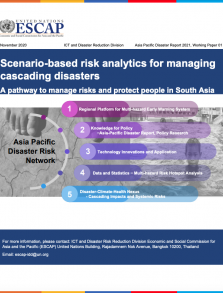
Scenario-based risk analytics for managing cascading disasters
Category
Manuals and Training Materials

The COVID-19 pandemic has made it clear that biological and natural hazards intersect with each other and increase the complexity of overall disaster impacts on populations and economies. But disaster management and risk analytics have been slow to capture the intersections of natural and biological hazards or capture the dimensions of interconnectedness and cascading effects to the social, economic, and environmental ecosystems. These challenging times call for a reformulation and paradigm shift from a single hazard, single sector perspective to a multi-hazard, multi-sectoral and systemic risk perspective. To achieve this, building multiple and complex risk scenarios that take the converging biological and natural hazard risks will be a priority. This study is a step in this direction. Through the integration of data from multiple sources, this study extends the riskscape of the region and examines the cascading risks that are arising and will arise in the future from the impacts of natural and biological hazards. Specifically, the study provides a methodology for building an integrated scenario assessment for strategic management and policy development in South Asia.

URL : Click to visit the source
Please switch to Chrome or MS Edge to improve your experience.
UNESCAP Logo
© United Nations ESCAP

Additional Links

  • UN Website
  • UN Website locator
  • Privacy Notice
  • Terms of Use
  • Fraud Alert

Get social with us

Newsletter

Subscribe to our monthly email newsletter.